High accuracy tracking on indoor/dry slopes
I’d like to suggest a feature for Carv: location-aware, per-section analysis using small Bluetooth beacons placed along a slope. On my home slope, a 300m red run at Snowworld Zoetermeer, the top is 21° and the lower ~75m is only 11°. In that flatter section I carry less speed, build less pressure and reach lower edge angles, which pulls down my overall Ski:IQ even when my carving on the steep part is good. Carv currently can’t separate the two, so I can’t see where I skied well and where I didn’t.
As someone with a few years of ski-racing experience, I know that analysis is one of the most important ways to improve your skiing. When you’re skiing the hardest, steepest part of your run, videos, photos and feedback are extremely useful for iterating and improving. Without people or video there to give me feedback, the only thing I have is the Carv 2 sensors and app. However, these tools don’t give me an overview of the run that accounts for the slower, less good lower part.
My idea is for Carv to create a simple module: a small Bluetooth beacon that active Carv apps can detect, so the app knows where on the slope the phone is. It works a bit like sonar: your position is determined by the beacons you are closest to.
This would allow much more detailed, per-section analysis that experienced skiers and racers could really use. It would also widen Carv’s customer base, from people learning to ski better, to experienced skiers looking to fine-tune, to actual racers, giving them in-depth feedback on where they skied well, what they did there, and how they can improve in specific conditions.
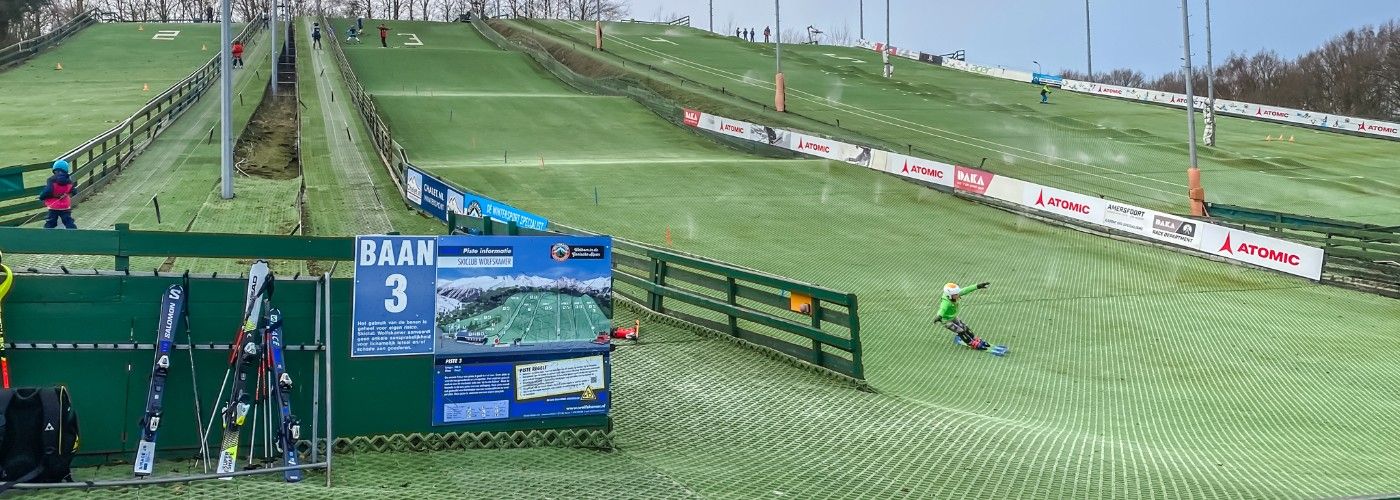
The system could also account for bumpy slopes. Think of Baan 3 at Wolfskamer in Huizen, a dry slope where I used to be on the racing team. We always trained on Baan 3, which has several large bumps that create different steepness and pressure requirements throughout the run (see the attached image).
Technically, the system could be kept simple and cheap. Small weatherproof Bluetooth beacons would be mounted at fixed points along the slope, for example at the top, at the transition between steep and flat, and at the bottom. Each beacon only broadcasts a unique ID, so the phone doesn’t need to pair with anything, and a coin-cell battery would last a long time. The Carv app, which already runs on the phone during a session, would log the signal strength of each beacon with a timestamp. Raw signal strength is noisy, so instead of estimating exact positions, the app would treat the moment of peak signal as a checkpoint, like a gate in a timing system. The Carv 2 sensors’ motion data (speed, edge angle, pressure) would then be split into segments between checkpoints, and each segment would get its own Ski:IQ and metrics. For bumpy slopes like Baan 3, beacons could be placed more densely, or the slope operator could store a simple profile (segment lengths and gradients) so the app can compare pressure and edge angle per feature instead of per run. All processing could happen on the phone after the run, so no live connection or extra hardware is needed.
If a system like this is implemented, you could even create api’s or other ways you link up professional timing gear for racers with their carv sensors & an app for an even more detailed report, with super accurate timing and anything you can imagine at this point.
Log in to comment and vote
Comments1
Team
Nov 6
Hi, thanks for such a detailed and well-thought-out suggestion! Using beacons as checkpoints to split a run into sections is a clever approach. Your examples from Snowworld Zoetermeer and Baan 3 show clearly how a flatter or bumpier section can hide good skiing elsewhere on the run. It’s great to hear how much your racing background shapes the way you use Carv!
We’ve passed this along to the team and will keep it in mind. Thanks again for sharing!
-Gracie with the Carv team